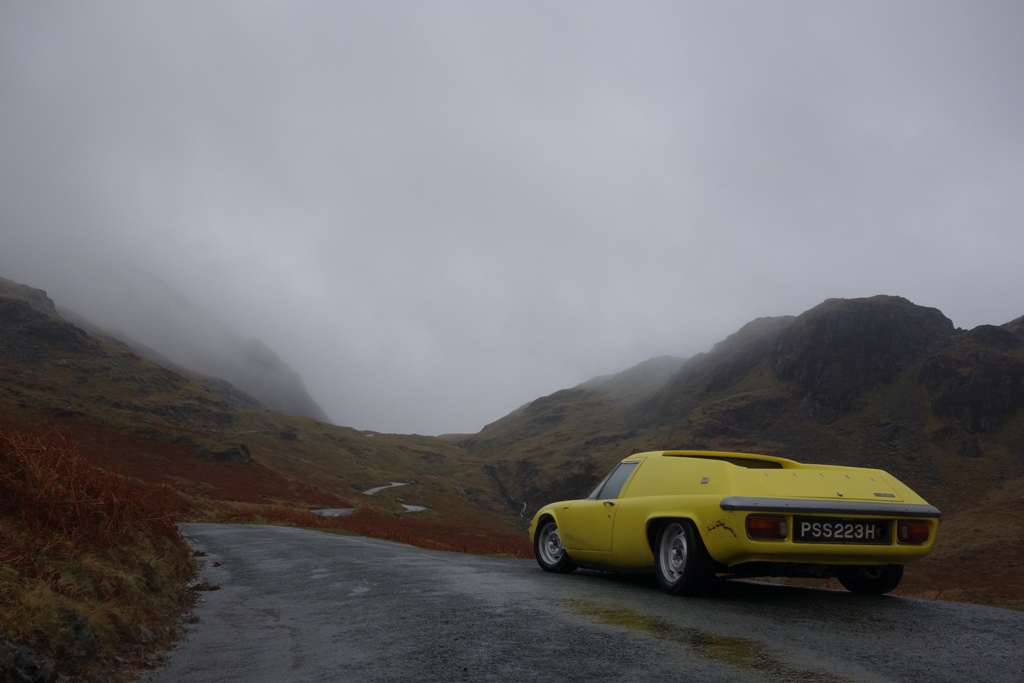
Lotus Europa
A Europa in good fettle requires concentration to drive. Even when they are right they can be little buggers on the limit. The steering is quick and keen to turn in, they are unstable. With practice you can make all four wheels slide and revel in this. Driving quickly there is little to no understeer. Unlike most cars, more throttle makes the front bite harder and will start to bring the rear around. Lift at this point and it will try and put you in a hedge. In the wet this is magnified. Wet weather and the light weight of the front end means aquaplaning, especially if you have wide tyres. Make no mistake, these can be nasty cars. When they are sorted and on the right road or track they are pretty unique. They can pull over 1g cornering on crossply tyres and the speeds you can enter corners takes some adjustment. They are more than capable of being driven slowly and apart from a tendency to follow lorry ruts are relaxing to do so. You can cover large distances in decent comfort and with some sound deadening are not to noisy either. Driving is what these cars are about and they present a challenge to do so well. In a decade I wouldn’t claim to have mastered it but here are my thoughts regardless.

The Europa has some interesting quirks; on standard suspension at least they have a curious trait of the front turning in and the rear following fractionally later. This is unsettling until you get used to it and seems a product of its geometry and rear suspension design. Suspension travel itself is quite limited meaning on bumpy roads its quite easy to use all of it. The ride is good for a sports car, its compliance makes it relaxing and the steering effort is light. Steering is unassisted, fast and direct. It is a very easy car to overcorrect when it starts to slide, minimal inputs are what it thrives on.
To drive it quickly you have to be very measured with steering input. On fast roads or track you rarely need more than a quarter turn of lock. You want to actively chase the throttle thorough the corner with the car loaded up. Corner speeds when doing this are very high, it doesn’t have the power for slow in fast out driving so maintaining momentum is the way to go. Oversteer in corners is more often a case of having lifted off and shifted the weight away from the rear rather than overpowering the rear tyres. It responds well to trail braking and if you want all four wheels to slide consistently, this is the best way of achieving it. It is important to emphasise the care needed on turn in when trail braking, the car does want to rotate and it needs careful managing to ensure it stays settled! Over bumpy tarmac it simply does not have the suspension travel to be driven like this unless you go stiffer on the spring rate.
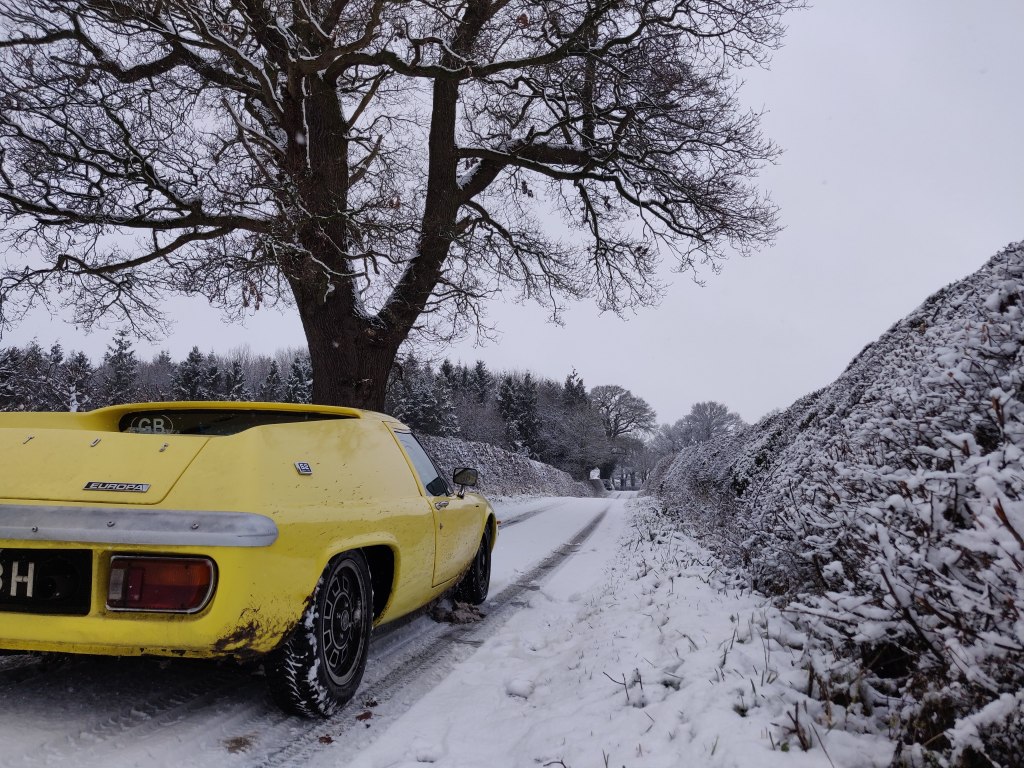
Poor gearchanges in these cars are well documented and even when everything is renewed they are not positive in the traditional sense. Hurrying the gears can result in beating the synchros so mechanical sympathy goes a long way. Learning where the gears are is important in a Europa, the gate feels different to most other cars and is not as well defined. With practice, fast gearchanges are possible but only relative to the period the car was made. Modern manual gearboxes are a robust joy in comparison.
Pedals are tightly squeezed together; people with feet over size 10 can struggle. Most cars you brake with the sole of your foot but in these the pedals are so close you need to use your toes. I use the side of my foot to heel and toe and when used to the size constraints it’s no more difficult than any other car. There is no rest for your clutch foot so on longer journeys I alternate between bringing up my left knee and resting it on the centre console or hooking my foot below the clutch assembly if I want to stretch. If you are over 1.8m you need to try driving one to make sure you fit before buying. The cabin is snug and the seats although adjustable do not go back that far. The clutch action is light enough but you cannot pivot your foot using your heel like a normal car. Instead you have to use your toes which at first makes pulling off a challenge. You get used to it…

Renault engine cars as standard feel underpowered. They still have a decent top speed because of the low drag coefficient but are always working hard. Engine swaps to more modern Renault crossflow units are commonly done. Unlike most classics, not having the original engine does not have a detrimental effect on the value. A crossflow swapped car is much more powerful and fast enough to work the chassis properly. Anything over 120bhp is fast enough coupled with the cars light weight to make them fun. Lotus Twin Cam cars are powerful enough as standard but can be tuned for more if desired.
Aerodynamically, Lotus put a lot of effort into creating a slippery shape. This is great for getting a high top speed with a low power engine and also makes them good on fuel. However, when fitted with something more powerful they have an even higher top speed and start to get unstable. The top speed of mine should be somewhere in the 130mph region but anything over 120mph and its starting to get genuinely unstable. Lotus themselves recognised this and fitted a front splitter to the Twin Cams to resolve it. Probably worth doing if you want to run at high speeds consistently.
Braking at high speeds will make the car move around. The degree to which it does this is dependent on fuel load, luggage, weight of driver and passenger and just how hard you are braking. Although I have never done it, I suspect it is entirely possible to spin one in a straight line by braking hard and insufficiently correcting the steering.
Stability is critically affected by the condition of the rear hubs. Driven normally the bearings last about 20,000 miles but driven hard this can decrease considerably. The hub splines wear as does the hub itself. When any of this happens and you get play in either of the rear wheels a Europa is genuinely dangerous. Depending on how bad the play governs how unstable the car gets. You will feel the car start to become more unbalanced but if you drive the car a lot you can adjust to it. It is worth checking the rear wheels regularly before the car spears itself through a hedge.
On the right piece of tarmac and on the right day this is a very very special car to drive. It is capable of going down a road with finesse and delicacy uncommon to most other cars. What it felt like to drive one of these in the 60s I can only guess but it must have been pretty spectacular. If you want challenging, rewarding and deeply flawed then perhaps you should consider one. I have had mine for a decade and driven it in some totally unsuitable situations. It has been reliable (by 60s Lotus standards) and I cannot for the life of me think what I could replace it with. The journeys, memories and yes its imperfections add up to something extraordinary. It’s enough to make an unsentimental man well, sentimental.

 The Driven Wheel